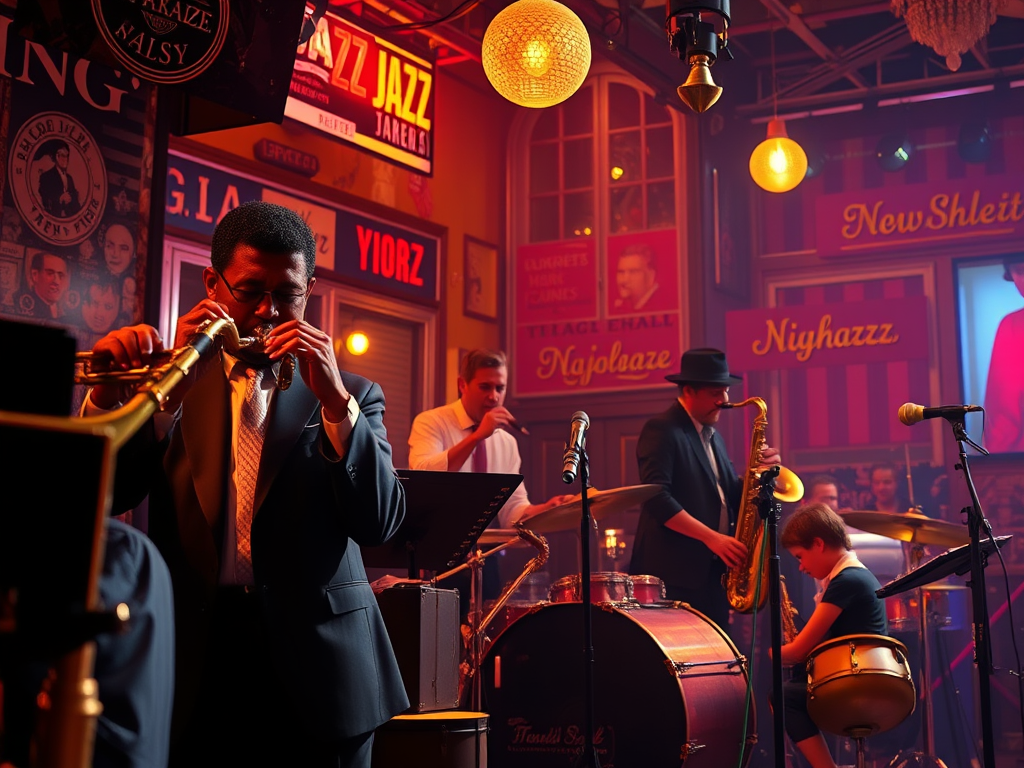
Jazz music originated in the late 19th and early 20th centuries in the United States, particularly in New Orleans, Louisiana. It developed from a fusion of African and European musical traditions, especially influenced by blues, ragtime, and spirituals. African-American communities played a central role in jazz’s formation, using music as a form of expression and resistance. Early jazz was characterized by improvisation, syncopated rhythms, and a strong sense of swing, often performed by small bands or solo pianists in clubs and social gatherings.
In the 1920s, known as the Jazz Age, the genre gained national prominence. This period saw jazz spread from New Orleans to cities like Chicago and New York. Musicians such as Louis Armstrong revolutionized jazz with their innovative solos and charismatic performances. The Harlem Renaissance also played a key role in promoting jazz as a respected art form. Jazz became a symbol of modernity and youth culture, influencing dance, fashion, and even literature during this vibrant decade.
The 1930s and 1940s ushered in the Swing Era, dominated by big bands led by artists like Duke Ellington, Count Basie, and Benny Goodman. Swing jazz featured larger ensembles and more structured arrangements while still allowing room for improvisation. During this time, jazz became widely popular across racial and class lines, with swing music frequently played in dance halls and on the radio. However, the 1940s also saw a shift toward more complex forms of jazz with the emergence of bebop, pioneered by musicians like Charlie Parker and Dizzy Gillespie.
Bebop represented a break from the mainstream swing style, emphasizing fast tempos, intricate melodies, and advanced harmonies. It was seen as more intellectual and was often performed in small combos rather than big bands. This evolution led to further experimentation in the 1950s and 1960s with the advent of cool jazz, hard bop, modal jazz, and free jazz. Musicians like Miles Davis and John Coltrane pushed boundaries, exploring new forms of expression and influencing countless other genres, including rock and funk.
By the late 20th and early 21st centuries, jazz had become a global phenomenon, with regional styles developing around the world. Jazz fusion blended jazz with rock, funk, and electronic music, while contemporary jazz continued to evolve through digital production and cross-genre experimentation. Today, jazz is celebrated both as a historical art form and as a living, evolving genre, with artists continually reinterpreting its roots while innovating for new audiences.
 JAI ON EARTH Discovering Our Planet
Leave a comment